Kenya safari guide

Kilimanjaro Safari

See Africa's highest mountain from Amboseli's elephant plains — or climb it from Tanzania and finish with a Kenya safari.

Two adventures, one mountain

Kilimanjaro safari — quick answer

Key Takeaways

A "Kilimanjaro safari" means two very different things — this guide covers both.

  • To SEE Kilimanjaro: the mountain is in Tanzania, but the best views are from Amboseli National Park in Kenya — elephants crossing dusty plains beneath the snow-capped dome. Go at dawn or late afternoon in the dry seasons (June–October, January–February).
  • To CLIMB Kilimanjaro: no technical skills needed, but a licensed guide is mandatory. Budget US$1,800–2,500 (budget), US$2,500–4,000 (mid-range) or US$4,000–7,000+ (luxury). Choose a longer route (7–9 days) for the best summit odds.
  • Best of both: a climb-plus-safari combo (climb first, safari after) is the most popular format — allow 10–14 days total.
  • Visa warning: the East Africa Tourist Visa does NOT cover Tanzania. You need a Kenya eTA AND a separate Tanzania e-visa for a cross-border trip.
The mountain

Mount Kilimanjaro basics

Mount Kilimanjaro is the highest mountain in Africa and the tallest free-standing mountain in the world, rising to a summit of 5,895 m (19,341 ft) at Uhuru Peak — the name means "freedom" in Swahili, chosen to mark Tanganyika's 1961 independence. It is a dormant stratovolcano built from three cones: Kibo (the highest and youngest, home to Uhuru Peak and the remaining glaciers), Mawenzi (5,149 m, extinct and craggy) and Shira (the oldest, now an eroded plateau).

Kilimanjaro sits inside Kilimanjaro National Park, a UNESCO World Heritage Site since 1987, and receives roughly 50,000 trekkers per year. Its glaciers — already reduced by more than 85% since 1912 — are expected to disappear by 2040–2060, making this increasingly a race against time.

No climb required

Seeing Kilimanjaro from Kenya: Amboseli

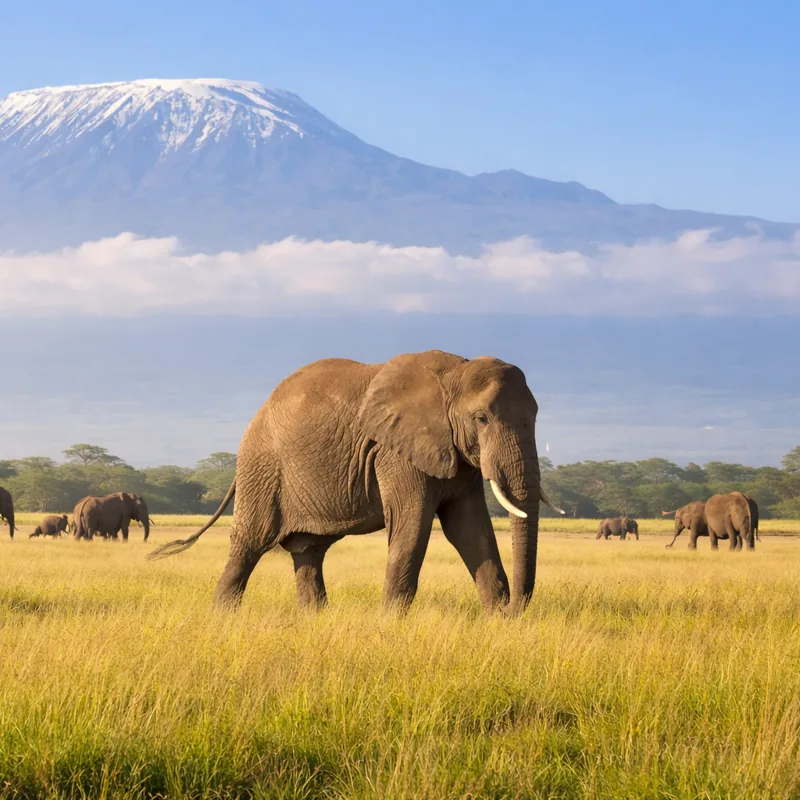
You do not have to climb Kilimanjaro — or even enter Tanzania — to experience it. The mountain's most celebrated views are from Kenya's Amboseli National Park, about 240 km southeast of Nairobi (a 4–5 hour drive or a 35–45 minute flight). Amboseli delivers the definitive African image: huge herds of elephants, including the last great "super tuskers," crossing dusty plains beneath the snow-capped dome.

When to look: clouds typically build around the peak by midday, so the mountain is clearest at dawn (roughly 6–8am) and late afternoon (roughly 5–7pm), especially in the dry seasons of June–October and January–February. Observation Hill — one of the few places you can leave your vehicle — gives a panoramic view over the swamps and plains with Kilimanjaro behind.

Amboseli isn't the only Kenyan vantage point. Tsavo West National Park offers dramatic views from spots like Poacher's Lookout, Roaring Rocks and Kilaguni Serena Lodge. The Chyulu Hills and the town of Oloitokitok also offer clear views on exceptional days. For the full Amboseli park guide, see our Amboseli National Park guide.

Best lodges for the Kilimanjaro view

  • Ol Tukai Lodge — classic in-park position facing the mountain
  • Amboseli Serena Safari Lodge — central location, mountain-view rooms
  • Tortilis Camp — in-park Kitirua concession, wide veranda views
  • Angama Amboseli — ultra-luxury on the Kimana Sanctuary
  • Kibo Safari Camp — budget-friendly, inside the national park

Photography tips

  • Shoot before 8am — cloud builds fast after sunrise.
  • Include foreground elements (elephants, acacia trees, Maasai herders) for scale.
  • Pack a long zoom (200–400mm equivalent) for elephant close-ups.
  • January–February offers the warmest light and clearest mountain conditions.
  • A clear summit is never guaranteed — even in the dry season.
Book the Kenya-side Kilimanjaro experience

Amboseli & Tsavo safari packages

The closest Kenya-side circuits to Kilimanjaro — combining Amboseli's iconic mountain-and-elephant views with Tsavo's red-dust elephants and Mzima Springs. Check live dates and availability:

Check live availability and prices on GetYourGuide. Pоwered by GetYourGuide.

Coming from Nairobi? Browse all 15 Kenya safari tours →

Stand on top of Africa

Climbing Kilimanjaro: routes & success rates

Kilimanjaro is a "walk-up" mountain — no ropes, crampons or technical climbing skills are required on the standard routes. The real challenge is altitude: at the summit there is up to 50% less oxygen than at sea level, and altitude sickness is the number-one reason climbers turn back. Success depends far more on acclimatisation time than on fitness, which is why route length matters enormously.

The industry-wide average success rate is roughly 65%, dragged down by short Marangu itineraries. The simple takeaway: spend more days on the mountain.

Kilimanjaro routes comparison
Route Typical days Approx. success rate Notes
Marangu ("Coca-Cola")5–6~27% (5-day), ~50–60% (6-day)Only huts; lowest success due to fast ascent
Machame ("Whiskey")6–7~65–85%Most popular; great varied scenery
Lemosho7–8~85–90%+Remote, scenic start; a top all-round pick
Rongai6–7~70–85%Only northern approach; driest in rainy months
Northern Circuit8–9~90–95%Longest route; highest success; very quiet

Guides are mandatory — solo climbing is illegal. Every climber must go with a licensed, registered guide and support crew (guide, assistant guide, cook, porters).

Worth adding to your itinerary

More Kenya safari experiences to explore

Combine your Kilimanjaro experience with Amboseli's elephant herds and iconic mountain views, the Masai Mara's dramatic river crossings, Tsavo's red-dust elephants and Mzima Springs, or flamingo flocks at Lake Nakuru. Browse experiences that fit your dates:

Pricing

How much does it cost to climb Kilimanjaro?

Kilimanjaro is not cheap, largely because of fixed park fees and the large mandatory support crew. Park fees alone (TANAPA conservation fee, camping/hut fees, rescue fee and 18% VAT) come to roughly US$800–1,000+ per person on a 7-day climb — the same for every operator, with no negotiation possible.

Kilimanjaro climb cost by tier
Tier Typical price per person What you get
BudgetUS$1,800–2,500Larger groups; bare essentials. Anything under ~US$2,000 risks underpaid porters or cut safety corners.
Mid-rangeUS$2,500–4,000The sweet spot: experienced guides, fair wages, good food, safety gear, small groups.
LuxuryUS$4,000–7,000+Private toilets, walk-in tents, gourmet meals, premium hotels pre/post-climb.
Budget extras on top: Crew tips (~US$250–350 per climber, mandatory by industry standard) · travel insurance with helicopter evacuation · gear rental US$200–500 · Tanzania e-visa US$50–100 · flights and pre/post-climb hotels. See our Kenya safari cost guide for the wider trip budget.
Timing

Best time to climb or view Kilimanjaro

The best time for both climbing and viewing is during the two dry seasons: January to mid-March and June to October. These windows offer the clearest skies, most stable weather and highest summit success.

Kilimanjaro timing by month
Period Climbing conditions Viewing from Amboseli
Jan–mid-MarDry, clear; excellent summit oddsBest views; warm, clear dawns; lowest crowds
Mid-Mar–MayLong rains; mud, poor visibility, lower successMountain often cloud-covered; lush scenery
Jun–OctPeak season; July–Aug busiest; Sep–Oct quieterClear peak views; dry season wildlife
Nov–DecShort rains; Rongai route best optionOccasional cloud cover; good value

These dry-season windows align perfectly with the best safari conditions across Kenya, including the Great Migration at the Masai Mara (July–October) and calving season in January–February. See our full best time to visit Kenya guide.

Safety on the mountain

Altitude, acclimatisation & preparation

Altitude sickness (AMS) can affect anyone regardless of age or fitness. The severe forms — HAPE (fluid in the lungs) and HACE (brain swelling) — are life-threatening and demand immediate descent. Key prevention measures:

On the mountain

  • "Pole pole" — Swahili for "slowly, slowly." Walking 2–3× slower than normal is the single best acclimatisation tool.
  • Choose a longer route with a "climb high, sleep low" profile — Lemosho, Northern Circuit or 7-day Machame.
  • Drink 3–4 litres of water per day; keep eating even when appetite fades.
  • Tell your guide about symptoms immediately. Good operators do twice-daily health checks with pulse oximeters and carry emergency oxygen.

Before you go

  • Train with cardio, weighted hill walking and any accessible altitude exposure.
  • Consult a doctor about Diamox (acetazolamide) — it aids acclimatisation but is no substitute for a slower pace.
  • Pack a summit-rated sleeping bag, thermal base layers, waterproof jacket, gaiters and trekking poles.
  • Summit temperatures can drop to −7°C to −20°C.
  • Buy comprehensive travel insurance with helicopter evacuation cover before you fly.
Climb + safari

Kilimanjaro & Kenya safari combo itineraries

Combining a climb with a Kenya safari is the most popular way to visit the region — and after days of high-altitude effort, a wildlife safari from a comfortable vehicle is exactly what a tired body needs. The near-universal advice: climb first, then safari, so you're fresh for the summit.

Kilimanjaro and safari combo itineraries
Length Style Typical shape
7–9 daysTime-crunchedShorter climb (Marangu/Machame 5–6 days) + 2–3 day Kenya safari
10–12 daysBalanced (best for most)Scenic climb (Lemosho/Machame 7–8 days) + 3–4 day safari
13–16 daysAll-inWell-paced climb + 5-day Kenya safari, sometimes plus a coast beach add-on

Kenya-side safari after the climb

After climbing, fly or drive into Kenya and combine Amboseli (for the elephant-and-Kilimanjaro experience from the Kenya side) with Tsavo East and Masai Mara for big cats and, in season, the Great Migration. The Namanga border crossing (open 24/7) is the main road link on the Nairobi–Moshi corridor — about 5–6 hours by shuttle bus or 1 hour by flight from Nairobi to Kilimanjaro International Airport (JRO).

Visa checklist for cross-border trips

⚠ Do not confuse the East Africa Tourist Visa with full Kenya + Tanzania coverage. The EAT Visa (US$100) covers Kenya, Uganda and Rwanda — it does not include Tanzania. For a climb-and-safari trip you need:
  • Kenya eTA — US$30 at etakenya.go.ke (most nationalities, applied online before travel)
  • Tanzania e-visa — US$50 for most nationalities, US$100 for US citizens
  • Carry a yellow fever certificate — often requested at the Kenya–Tanzania border
Plan with confidence

Kilimanjaro safari FAQ

Is Mount Kilimanjaro in Kenya or Tanzania?

Kilimanjaro is entirely in Tanzania, just south of the Kenya border. The best and most famous unobstructed views, however, are from Kenya's Amboseli National Park — where elephants cross the plains beneath the snow-capped peak. See our Amboseli guide for how to plan the visit.

Can you see Kilimanjaro from Amboseli?

Yes — Amboseli offers arguably the finest views of Kilimanjaro anywhere. The peak is clearest at dawn and late afternoon in the dry seasons (June–October and January–February). Clouds build around the summit by midday, and a clear view is never guaranteed. Observation Hill is the best vantage point inside the park. For tips on timing and photography, see our Amboseli National Park guide.

What is the best time to see or climb Kilimanjaro?

Both January to mid-March and June to October are ideal for climbing (clearest skies, highest summit success) and for viewing the mountain from Amboseli. July–August is busiest and most expensive for climbing; September–October is quieter with excellent conditions. These dry windows also overlap with Kenya's best game-viewing season — see our best time to visit Kenya guide.

How much does it cost to climb Kilimanjaro?

Budget US$1,800–2,500 for a group/budget climb, US$2,500–4,000 for a mid-range option with a reputable operator, and US$4,000–7,000+ for luxury. Park fees alone are roughly US$800–1,000 per person and are non-negotiable. Add crew tips (~US$250–350), travel insurance with helicopter evacuation, gear, flights and pre/post-climb accommodation. Avoid prices under ~US$2,000 — they typically cut safety or porter wages.

Should I do the safari before or after climbing Kilimanjaro?

After — the near-universal recommendation. Tackling the summit while fresh, then recovering with low-altitude game drives, is both physically and logistically superior. A typical combo runs 7–8 days on the mountain followed by 3–4 days on safari in Amboseli and the Masai Mara.

Can beginners climb Kilimanjaro?

Yes — no technical climbing skills are needed and beginners with reasonable fitness summit regularly, as long as they choose a longer route (8-day Lemosho or 9-day Northern Circuit), walk at a very slow "pole pole" pace, and give altitude the respect it demands. The main danger is altitude sickness, not the terrain. Arrive as fit as possible and build in extra acclimatisation days if budget allows.

Can you do a day hike on Kilimanjaro without committing to the summit?

Yes. The Marangu Gate to Mandara Hut hike (2,700 m) is a popular 3–4 hour rainforest walk through colobus and blue monkey habitat, with a short side trip to Maundi Crater. It typically costs US$170–300 per person including park fees, guide and lunch — suitable for families and beginners. A summit attempt still requires 5–9 days.