Kenya wildlife guide

Kenya's Big Five (and Big Nine)

Where to see lion, leopard, elephant, buffalo and rhino — plus the complete Big Nine checklist — with the latest 2025 census data and expert viewing tips.

Quick facts

Kenya's Big Five at a glance

Key Takeaways

Kenya is one of the best places on Earth to see all five of the Big Five safari animals — lion, leopard, elephant, Cape buffalo and rhino — and is one of the only places where you can see all nine of the "Big Nine" in a single day.

  • 2025 census numbers: roughly 2,512 lions, 42,072 elephants, 2,102 rhinos (1,059 black, 1,041 white, 2 northern white) and 27,389 buffalo recorded nationally. Leopards were not nationally censused — too elusive.
  • No single park has all five reliably. The classic fix: combine the Masai Mara (lion, leopard, elephant, buffalo) with Lake Nakuru or Ol Pejeta (rhino) in a 7–10 day circuit.
  • Leopard is the hardest of the five to see. Rhino is the rarest and most location-dependent.
  • The Big Nine adds cheetah, giraffe, hippo and zebra — and the Masai Mara can realistically deliver all nine in one day.

The term "Big Five" was coined by 19th-century big-game hunters — not for size, but for the five species considered most dangerous and difficult to hunt on foot. Today the phrase belongs entirely to conservation-driven safari tourism, and Kenya sits at the heart of that story. Check live availability for a Masai Mara + Lake Nakuru safari below — our most popular Big Five circuit.

Check live availability and prices on GetYourGuide. Pоwered by GetYourGuide.
Worth adding to your itinerary

Other Kenya safari experiences to consider

A Big Five safari pairs naturally with the best of Kenya's wildlife circuits. Many travellers combine the Masai Mara's lions and cheetahs with the elephants of Amboseli beneath Mount Kilimanjaro, the rhinos and flamingos of Lake Nakuru, the hippos of Lake Naivasha, and the special five of Samburu. Browse experiences that fit your dates:

Big Five #1

Lion — the king of the savannah

The lion is Africa's largest cat and its only truly social one, living in prides of related females, their cubs and a coalition of males. Lionesses do most of the hunting — cooperatively pursuing zebra, wildebeest and buffalo — while males defend territory. A roar carries for several kilometres.

Kenya status (2025 census): approximately 2,512 lions nationally. Listed as Vulnerable on the IUCN Red List. Strikingly, the vast majority of Kenya's lions live outside formally protected areas, making human–wildlife conflict — retaliatory killing after livestock predation — the single biggest threat alongside habitat loss.

Best parks: the Masai Mara has Kenya's highest lion density. Amboseli, Tsavo, Lake Nakuru and Samburu are also reliable.

Viewing tip: Look for lions at first light and late afternoon; midday they sleep flat in shade. Shoot at eye level with a beanbag on the vehicle door — focus always on the eyes.

Big Five #2

Leopard — the ghost of the bush

The most elusive of the Big Five — solitary, largely nocturnal, superbly camouflaged, and the only big cat that regularly hauls kills into trees to protect them from lions and hyenas. Rosettes (not solid spots like a cheetah) and a long, white-tipped tail distinguish it.

Kenya status: leopards were not formally counted in the 2025 national census — explicitly listed among species still requiring dedicated surveys. They persist widely across Kenya but at naturally low densities, and are considered globally vulnerable.

Best parks: Samburu is often cited as Kenya's single best leopard destination — arid woodland, rocky outcrops and riverine bush concentrate the cats in predictable spots. The Masai Mara's private conservancies (especially with night drives) and Laikipia — famous for rare melanistic (black) leopards — are also excellent.

Viewing tip: Sightings are won before you see the cat — listen for alarm calls from baboons, impala and francolins. Where night drives are permitted (private conservancies), your odds rise sharply.

Big Five #3

Elephant — a conservation success story

The African savanna elephant — Earth's largest land animal — lives in matriarchal family herds led by the oldest, most experienced female. Their intelligence, memory and emotional lives are extraordinary: knowledge held by old matriarchs about where to find water and how to avoid danger is central to herd survival.

Kenya status (2025 census): approximately 42,072 elephants — up from 36,280 in 2021, and a stunning recovery from the estimated 16,000 at the height of the 1989 poaching crisis. Sustained anti-poaching enforcement, the ivory ban and community conservancies drove the comeback. Despite this, the African savanna elephant remains Endangered on the IUCN Red List, with habitat loss and climate-driven drought now the dominant threats.

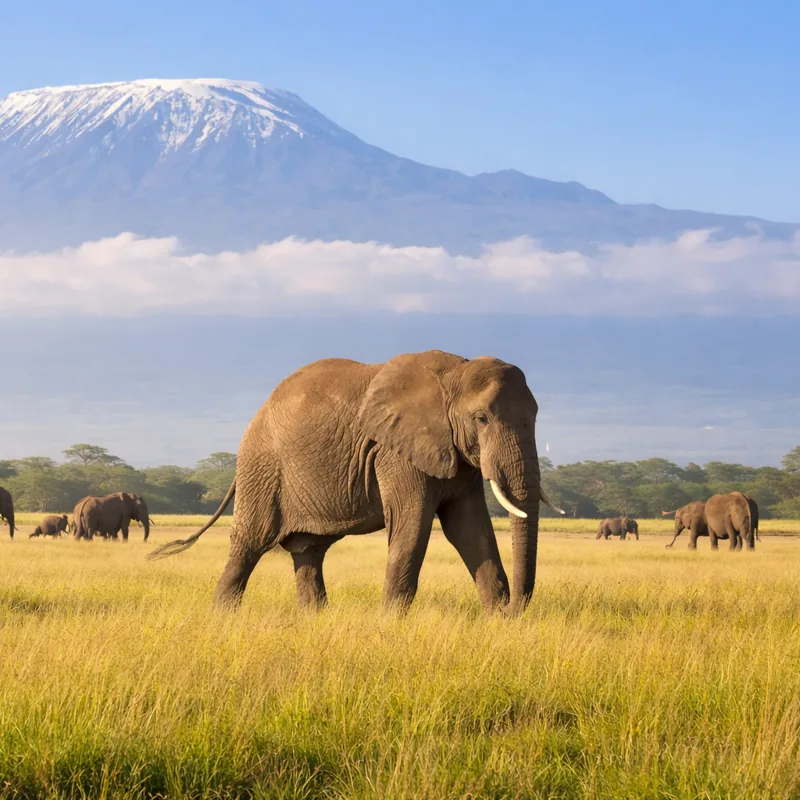
Best parks: Amboseli for iconic large herds against a Kilimanjaro backdrop (home of the Amboseli Elephant Research Project, founded in 1972). Tsavo holds Kenya's largest population — its "red elephants" are dust-bathed in volcanic red soil. Samburu is also excellent.

Viewing tip: Mid-morning at water sources is prime in the dry season. Give them room — always.

Big Five #4

Cape buffalo — the black death

Don't let the cow-like look fool you. The Cape buffalo is widely regarded as the most dangerous of the Big Five to encounter on foot — nicknamed "Black Death" for its tendency to ambush and charge. Buffalo live in herds from dozens to over a thousand, and females even "vote" on which direction to move. Solitary old bulls ("dagga boys") are the most unpredictable.

Kenya status (2025 census): approximately 27,389 rangeland buffalo. Buffalo are the most numerous and easily seen of the Big Five, found in nearly every major park.

Best parks: virtually everywhere — the Masai Mara (tens of thousands), Amboseli, Tsavo, Lake Nakuru and Aberdare. Buffalo are rarely the animal you have to search for.

Viewing tip: Large herds photograph beautifully in dust and low light. Watch for oxpecker birds on their backs — a sign of healthy individuals. Keep a respectful distance, especially from lone bulls and cows with calves.

Big Five #5

Rhino — Kenya's anti-poaching triumph

Kenya has two species. The black rhino is a browser with a hooked upper lip, prefers dense bush, and is more solitary and short-tempered. The white rhino is a grazer with a wide, square lip, is more social, and easier to see in open grassland. (The "white" is a corruption of a word meaning "wide," not a colour — both are grey.)

Kenya status (2025 census): approximately 2,102 rhinos in total — 1,059 eastern black rhinos (Critically Endangered), 1,041 southern white rhinos (Near Threatened), and just 2 northern white rhinos at Ol Pejeta Conservancy. Kenya is now the third-largest rhino population in Africa after South Africa and Namibia — a stunning recovery from fewer than 400 in the 1980s. Poaching has plummeted; Kenya has recorded years with zero rhino poaching.

The world's last two northern white rhinos — Najin and her daughter Fatu — live under 24-hour armed guard at Ol Pejeta. The last male, Sudan, died in 2018, making the subspecies functionally extinct in the wild. The BioRescue consortium is pursuing IVF, having produced 39 pure northern white rhino embryos by early 2026, though no surrogate pregnancy has yet been carried to term.

Best parks: Lake Nakuru National Park is the most reliable single park to see both black and white rhinos, often near the lakeshore. Ol Pejeta Conservancy is East Africa's largest black rhino sanctuary with near-guaranteed sightings and the last northern whites. Solio Ranch and Lewa Conservancy also hold exceptional populations.

Viewing tip: Rhinos have poor eyesight but keen hearing and smell — keep noise down. White rhinos in open grassland at Nakuru or Solio offer the easiest daytime shots; black rhinos in dense bush demand patience.
Book your safari

Popular Big Five Kenya safari tours

These multi-park tours from Nairobi are designed to cover both the Masai Mara (lion, leopard, elephant, buffalo) and Lake Nakuru (rhino), giving you the strongest chance of completing the Big Five in one trip.

4-Day Masai Mara & Lake Nakuru — Check availability & prices

Need help choosing a route? See our Kenya safari itineraries for ready-made 3, 5, 7 and 10-day options.

Beyond the original five

The Big Nine: Africa's extended checklist

The "Big Nine" keeps the original five and adds four more iconic animals — cheetah, giraffe, hippopotamus and zebra. The Masai Mara markets itself as a Big Nine reserve precisely because you can realistically see all nine there in a single day.

Practical planner

Where and when to see each Big Five animal

Where and when to see Big Five in Kenya
Animal Best Kenya parks Difficulty Best time of day
LionMasai Mara (highest density), Amboseli, Tsavo, Samburu, Lake NakuruEasy–moderateEarly morning & late afternoon
LeopardSamburu, Mara conservancies, Laikipia, TsavoHard (toughest of the five)Dusk, night drives, early morning
ElephantAmboseli (big herds), Tsavo (largest population), SamburuEasyMid-morning & late afternoon at water
BuffaloMasai Mara, Amboseli, Tsavo, Lake Nakuru, AberdareEasy (most numerous)Any time; often near water
RhinoLake Nakuru (both species), Ol Pejeta, Solio, Lewa, Ngulia/Tsavo WestModerate (park-dependent)Early morning & late afternoon

Itinerary logic: The most efficient Big Five route combines the Masai Mara (lion, leopard, elephant, buffalo) with a dedicated rhino destination such as Lake Nakuru or Ol Pejeta. A 7–10 day Masai Mara + Lake Nakuru + Amboseli circuit, or Masai Mara + Ol Pejeta, gives most travellers all five. See our Kenya safari itineraries for ready-made routes.

Why it matters

Conservation: the threats and Kenya's success stories

Kenya's Big Five tell two very different conservation stories. Elephants and rhinos are genuine recoveries — decades of anti-poaching enforcement, the ivory ban and community conservancies have driven elephants from ~16,000 (1989) to over 42,000, and rhinos from a few hundred to Africa's third-largest population. Poaching has been dramatically reduced.

The harder stories are the big cats. Lions remain Vulnerable and mostly live outside protected areas, where human–wildlife conflict — particularly retaliatory killing after livestock predation — is intense. The 2025 census flagged worrying declines in cheetahs, wild dogs and several plains species. Climate change and drought compound the pressure: the 2022 East Africa drought, one of the worst in 40 years, killed hundreds of elephants, wildebeest, zebras and giraffes in Amboseli alone.

Kenya's most promising tool is community-based conservation — conservancies that give local people a direct financial stake in living wildlife, programs like Lion Guardians that reduce retaliatory killings, and wildlife corridors that link fragmented habitats. When you book an ethical safari, your visit directly funds this work.

Plan with confidence

Big Five Kenya FAQ

Where can I see the Big Five in Kenya?

No single park reliably has all five, because rhinos are the limiting factor. The classic solution: combine the Masai Mara (lion, leopard, elephant, buffalo) with Lake Nakuru or Ol Pejeta (rhino) in a 7–10 day circuit. See our Kenya safari itineraries for ready-made routes.

What are the Big Five animals?

The lion, leopard, African elephant, Cape buffalo and rhinoceros. The term was coined by 19th-century big-game hunters for the five species considered most dangerous and difficult to hunt on foot — it has nothing to do with size, and today it's fully owned by conservation and safari tourism.

What is the hardest of the Big Five to see in Kenya?

The leopard — solitary, largely nocturnal and superbly camouflaged. Samburu National Reserve, the Masai Mara's private conservancies (especially with night drives permitted) and Laikipia — home to rare melanistic (black) leopards — offer the best chances.

Are there rhinos in Kenya?

Yes. Kenya's 2025 census counted approximately 2,102 rhinos — around 1,059 black, 1,041 southern white, and the world's last 2 northern white rhinos at Ol Pejeta Conservancy under 24-hour armed guard. Kenya now has the third-largest rhino population in Africa after South Africa and Namibia.

What is the Big Nine?

The Big Five plus cheetah, giraffe, hippopotamus and zebra — a more inclusive modern safari checklist. The Masai Mara is one of the few places on Earth where you can realistically see all nine in a single game drive.

Can I see all Big Five in the Masai Mara?

Almost — the Mara reliably delivers lion, leopard, elephant and buffalo, but rhinos are rare and hard to find there. Most travellers add a dedicated rhino park (Lake Nakuru or Ol Pejeta) to complete the set. For the Mara's full picture, see our Masai Mara guide.

Ready to go

Plan your Big Five Kenya safari

Seeing all five in one trip isn't luck — it's planning. Our curated multi-park circuits put you in the right parks at the right time, with expert guides who know the individual leopard territories, the Mara's lion prides and exactly which rhino sanctuaries deliver. Browse our most popular safaris and check live availability.

Browse Big Five safaris