Complete your Kenya safari
Parks that pair well with a migration safari
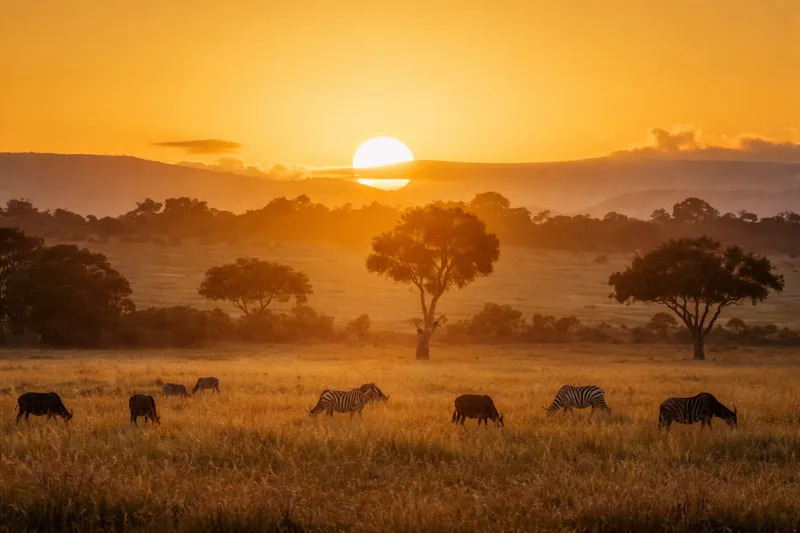
Most travellers combine the Mara's crossings with one or two complementary parks for a fuller picture of the country's wildlife.
Kenya safari guide
A month-by-month guide to the wildebeest migration, the Masai Mara river crossings, and how to give yourself the best chance of witnessing nature's greatest spectacle.
Key Takeaways
The Great Migration is a continuous, year-round clockwise loop of roughly 1.3–1.5 million wildebeest plus hundreds of thousands of zebra and gazelle around the Serengeti–Mara ecosystem shared by Tanzania and Kenya. It is not a single event.
The popular image of wildebeest plunging across a crocodile-filled river is only one dramatic chapter of a 12-month story driven entirely by rainfall — the herds follow the rains and the flush of nutritious new grass. Below you'll find the full annual cycle, Kenya's key crossing points, and a practical playbook for loading the dice in your favour. Most Mara migration safaris depart from Nairobi and bundle transfers, park fees, accommodation and game drives — check live availability and current prices below.
The Great Wildebeest Migration is the largest overland movement of animals on Earth. Every year around 1.3–1.5 million wildebeest, joined by roughly 200,000–400,000 zebra and several hundred thousand Thomson's and Grant's gazelle, travel a continuous clockwise circuit through the Serengeti–Mara ecosystem that straddles northern Tanzania and southwestern Kenya. Each animal covers something like 800–1,000 km over the course of a year in an endless search for fresh grazing and water.
Crucially, the migration is not a single event with a start and a finish — it is a perpetual cycle of movement, birth, predation and survival. The whole thing is driven by rainfall. The spectacle is recognised as one of the Seven Natural Wonders of Africa, a designation declared at a ceremony in Arusha, Tanzania, in February 2013, where the Serengeti Migration was named the single most-voted wonder on the continent.
For roughly half a century the widely cited figure has been around 1.3 million wildebeest, based on aerial surveys. That number remains the standard reference. However, a 2025 University of Oxford–led study applied AI models to high-resolution satellite imagery and returned lower counts within its surveyed area — a figure the authors themselves later clarified (in a December 2025 correction in PNAS Nexus) "cannot be extrapolated to the entire population." The responsible takeaway: the migration remains a mass movement of well over a million animals in aggregate, but the precise total is genuinely uncertain and under active study.
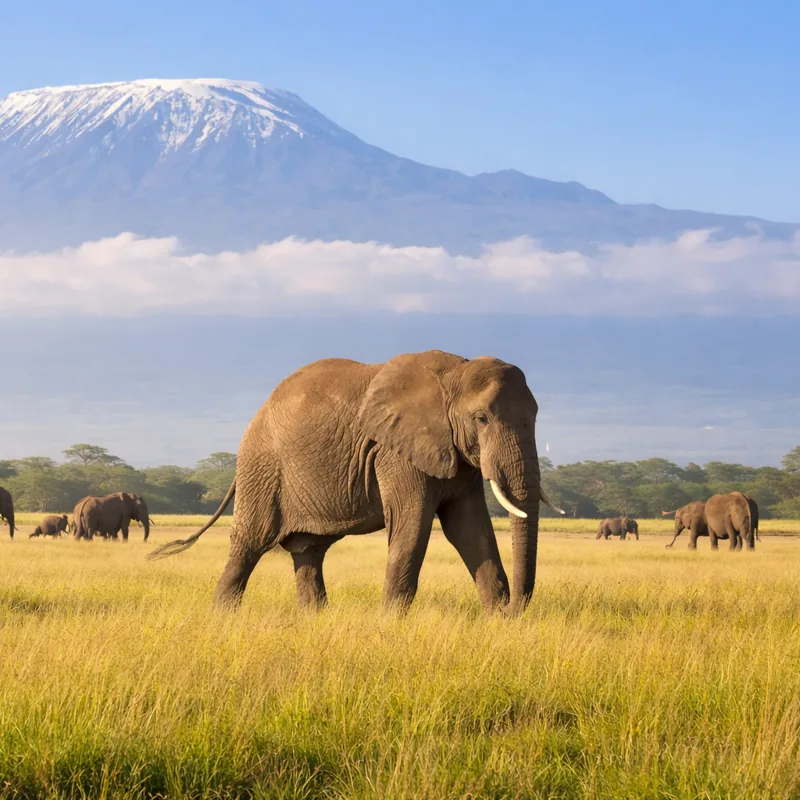
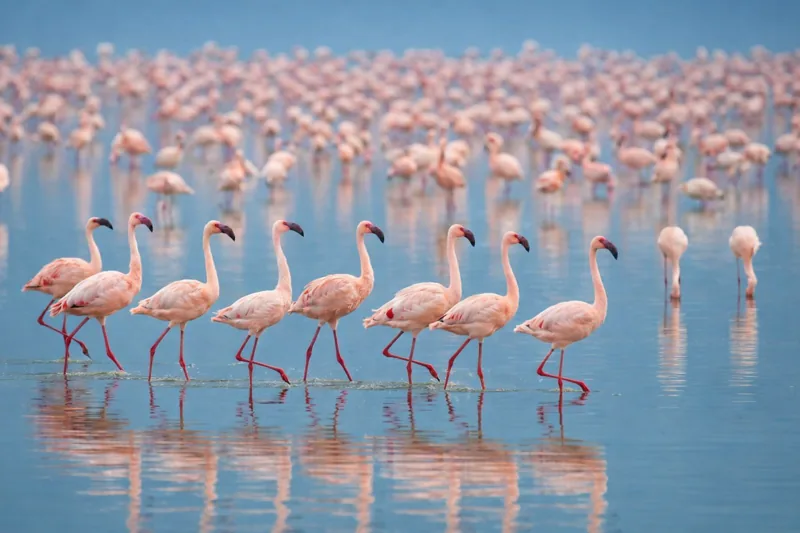
A migration safari pairs naturally with the rest of Kenya's greatest hits. Combine your Masai Mara river-crossing days with Amboseli's elephant herds beneath Mount Kilimanjaro, the flamingo flocks and rhino sanctuary of Lake Nakuru, hippo boat cruises at Lake Naivasha, or a dawn hot-air balloon safari over the plains. Browse experiences that fit your dates and interests:
The migration is best understood as a single loop shared by two countries. Tanzania's vast Serengeti hosts the herds for roughly nine to ten months and is the breeding ground; Kenya's smaller Masai Mara is the dry-season refuge where the most concentrated drama unfolds for three to four months. Here is where the herds typically are, month by month.
| Months | Location | What's happening |
|---|---|---|
| Jan–Feb | Southern Serengeti & Ndutu (Tanzania) | Calving season — around 500,000 calves born; intense predator action |
| Mar | Southern Serengeti / Ndutu | Calving tails off; green plains, superb photography light |
| Apr–May | Central & western Serengeti | Long rains; herds move north and west in long columns; rutting begins |
| May–Jun | Western Corridor, Grumeti River (Tanzania) | Grumeti River crossings in a short 1–2 week window |
| Jul | Entering Kenya's Masai Mara via the Sand River | First herds cross into Kenya; Mara River crossings begin |
| Aug | Masai Mara (Kenya) & northern Serengeti | Statistical peak of Mara River crossings — and the highest vehicle numbers |
| Sep | Masai Mara (Kenya) | Herds graze the lush plains; crossings continue; intense big-cat action |
| Oct | Masai Mara, beginning to move south | Short rains build south of the border; southward crossings; fewer crowds |
| Nov–Dec | Northern/eastern & southern Serengeti (Tanzania) | Herds drift south; gather on the short-grass plains as the cycle begins again |
If the Great Migration is Kenya's greatest wildlife event, the Mara River crossings are its defining moment. The river carves through the northern Serengeti and the Masai Mara, forming a natural barrier the herds must cross — often twice — as they move north into Kenya (roughly July to October) and back south into Tanzania (roughly September to November).
Three forces make the crossings deadly: fast, deep currents in which exhausted animals drown; steep, muddy banks where legs break and stragglers are trampled; and the Nile crocodiles — the Mara holds one of the highest concentrations of large crocodiles in Africa. On the far bank, lions and hyenas wait for the survivors.
Nobody can predict a crossing with certainty — it depends on the rains and the notoriously indecisive wildebeest, who may gather at the bank for hours or days before one animal finally commits and thousands follow in minutes. Experienced guides tilt the odds by watching herd behaviour and using radio networks to share real-time position reports. A knowledgeable, well-connected guide is one of the single biggest factors in whether you witness a crossing.
Big herds in the Mara from July to October are very likely. An actual river crossing is never guaranteed — some travellers wait four full days and see nothing; others witness one within fifteen minutes. Here is how to load the dice in your favour.
These multi-day tours run from Nairobi, put you in the Mara for the July–October crossing season, and cover transfers, accommodation and game drives. Check live availability and current prices below.
Want to see how many nights you'll need and what it costs? Read our Kenya safari itineraries and Kenya safari cost guides.
From late January to mid-March, on the short-grass plains of Ndutu and the southern Serengeti, around 500,000 calves are born in a matter of weeks — a synchronised strategy called predator swamping. It brings the most intense predator action of the year. This requires travelling to Tanzania, not Kenya — see our best time to visit Kenya guide for how the seasons align.
Even outside the migration months, the Masai Mara is one of the richest wildlife destinations on Earth — home year-round to the Big Five and one of the densest predator populations in Africa. In other words, a Mara safari is spectacular whenever you visit. For the full picture, see our Masai Mara ultimate guide and accommodation guide.
Nothing conveys the sheer scale of the migration like floating above it at dawn. A sunrise hot-air balloon safari over the Masai Mara — typically a one-hour flight followed by a champagne bush breakfast — offers a perspective no game drive can match. Expect an early start (pickup around 5 a.m.) and a price in the region of $450–$550 per person, rising during peak season. Book well ahead, as daily slots sell out fast in July–October.
Budget for Masai Mara National Reserve entry, set by the Narok County Government, of US$100 per non-resident adult per day from 1 January to 30 June 2026, and US$200 per day from 1 July 2026 onwards (the peak migration period). Children aged 9–17 pay US$50 year-round; under-8s are free.
Most safari packages bundle park fees; always check the "what's included" line. For a full cost breakdown see our Kenya safari cost guide.
The migration is the ecological engine of the entire Serengeti–Mara ecosystem — the herds' grazing shapes the grasslands, their carcasses drive nutrient cycling, and their numbers sustain the region's predators and scavengers. That system is under mounting pressure. The chief threat is land-use change — the spread of agriculture, roads, settlements and especially fencing — which fragments the corridors the herds have used for generations. New mapping found the smaller Mara-Loita migration has lost roughly 90% of its historic footprint since 2020 to man-made barriers.
Climate change compounds the danger by altering the rainfall on which the whole cycle depends. Because the ecosystem is split by the Kenya–Tanzania border, its survival depends on transboundary conservation. As a traveller, choosing responsible operators, respecting park rules, and supporting community conservancies — which give local Maasai landowners a direct stake in keeping land open and unfenced — is one of the most tangible ways to help the migration endure.
Most travellers combine the Mara's crossings with one or two complementary parks for a fuller picture of the country's wildlife.
Roughly July to October, when the herds are in the Masai Mara and the Mara River crossings occur. August and September are the peak crossing months. October offers the migration with fewer crowds as the herds begin heading back to Tanzania. See our month-by-month Kenya guide for detail.
No. Big herds in the Mara from July to October are very likely, but an actual river crossing can never be guaranteed. Crossings depend on rainfall and the unpredictable herds, who may wait at the bank for days. Staying several nights and using an expert guide greatly improves your odds.
A minimum of 3–4 nights near the Mara River is recommended, and 4–5 nights if a crossing is your top priority. More days mean more attempts — some travellers wait several days without success, so length of stay is the single biggest factor within your control. Our Kenya safari itineraries guide shows how to build in the nights.
Both. The migration is a single continuous loop that crosses the international border. Tanzania's Serengeti hosts the herds for most of the year and is the breeding ground; Kenya's Masai Mara is the dry-season refuge where the most concentrated crossings take place. The two ecosystems are complementary halves of one phenomenon.
Yes. The herds spend roughly nine to ten months in Tanzania's Serengeti. The calving season (January–March) and the Grumeti River crossings (May–June) happen in Tanzania, while Kenya's Masai Mara stages the famous Mara River crossings from July to October.
The long-standing estimate is around 1.3–1.5 million wildebeest, plus hundreds of thousands of zebra and gazelle. A 2025 Oxford-led study using AI and satellite imagery counted fewer within its surveyed area, but the authors later clarified the figure should not be extrapolated to the whole population. The migration remains a mass movement of well over a million animals.
Timing a migration safari is an art — the difference between a rushed trip and a once-in-a-lifetime experience comes down to being in the right place, at the right time, with the right guide. Browse our most popular Masai Mara safaris and check live availability for your dates.